ByJohn A
Are Peptides Steroids? Clearing Up the Confusion
Are peptides steroids?
No. Peptides are short amino-acid chains that signal cells through surface receptors; anabolic-androgenic steroids are lipid hormones on a cholesterol skeleton that act on the androgen receptor inside the cell. Separate molecular classes, separate mechanisms. A handful of peptides sit on anti-doping lists, but a sporting ban is not a chemical reclassification. A supervised provider is the lawful way to obtain one.
The mix-up is everywhere, and it is easy to see why. Both get sold to the same gym audience, both promise recovery and lean mass, and both show up on the same banned-substance lists in pro sport. None of that makes them the same thing chemically. The sensible approach is to start with the molecules, then deal with the regulatory and sporting confusion that rides on top, and finally rank the sources someone would actually use if they decided a clinician-guided peptide made sense for them. The class question and the sourcing question are separate, and people who blur them tend to make worse decisions on both.
How I weighed the sources
For the ranking I scored each option on plain questions a careful person can check before buying anything. Because the headline confusion is about safety and legitimacy, I put clinical accountability and legal standing at the front.
- Does a licensed clinician have to approve you first? A prescriber who reviews your history before anything ships is the dividing line between supervised care and a research chemical.
- Is the catalog wide enough to cover what you came for? A source that carries one or two compounds forces you back into a second relationship for the rest.
- Is a named, FDA-registered 503A pharmacy in the chain? Sterile injectables belong to a specific compounding facility working under USP-797 and cGMP.
- Where does it sit in the 2026 rules, supervised or research-use-only?
- Is it straight about FDA status? Compounded products are not FDA-approved, and the human evidence for most non-GLP-1 peptides is thin. Saying so beats implying otherwise.
Several entries below sell their goods for laboratory research only. That labeling is read as written and each is judged on its real attributes. A research-use-only vendor is a different product class, not a fraud by default, but it carries no prescriber, no pharmacy license, and no one answerable for a human result.
The chemistry: why a peptide is not a steroid
Start with what each molecule is. A peptide is a string of amino acids joined by peptide bonds, usually somewhere between two and fifty of them. BPC-157 runs fifteen amino acids; sermorelin runs twenty-nine. They are water-loving molecules that bind a target receptor on a cell surface and pass along a signal, then break down quickly into their component amino acids. Most do not survive the gut, which is why they tend to be injected.
A steroid is built on a four-ring carbon core derived from cholesterol. Testosterone and its synthetic anabolic cousins are fat-soluble, slip straight through the cell membrane, and bind the androgen receptor inside the cell, where they switch genes on and off across muscle, bone, skin, and the reproductive system. That direct androgen-receptor action is what drives both the size gains and the well-documented harms, from suppressed natural testosterone to cardiovascular and liver strain.
So the gap is structural and mechanistic, not a matter of degree. One is a short amino-acid signal; the other is a ring-shaped lipid hormone. A growth-hormone secretagogue such as CJC-1295 with ipamorelin nudges the pituitary to release a pulse of the body’s own growth hormone. That is a world away from pouring a synthetic androgen into the receptor directly. Calling a peptide a steroid is like calling a text message a phone call because both carry words.
Why the confusion sticks
If the chemistry is that clear, why does the question keep coming back. Three reasons, and each is worth separating from the science.
First, marketing. Grey-market sites sell peptides with steroid-flavored language, leaning on words like anabolic and cycle because that vocabulary moves product to lifters. The pitch borrows the steroid frame on purpose.
Second, anti-doping lists. The World Anti-Doping Agency prohibits several peptides, growth-hormone secretagogues and growth-hormone-releasing factors among them, in the same code that bans anabolic agents. A reader skimming the list sees peptides and steroids under one banner and assumes one category. The code groups them because both can enhance performance, not because they are the same kind of molecule. A prohibited-list entry is a sporting rule, not a chemical classification.
Third, the regulatory noise of 2026, which gets misread as a steroid crackdown. On April 15, 2026, the FDA took several peptide bulk substances off the 503A Category 2 list, a move that traced to withdrawn nominations rather than a safety reversal. The agency’s Pharmacy Compounding Advisory Committee then set hearing days for July 23 and 24, 2026, under docket FDA-2025-N-6895, to weigh seven peptides including BPC-157, TB-500, and MOTS-c. These compounds are under review, not banned, and none of that turns a peptide into a steroid.
The ranking: 8 peptide sources, best to least
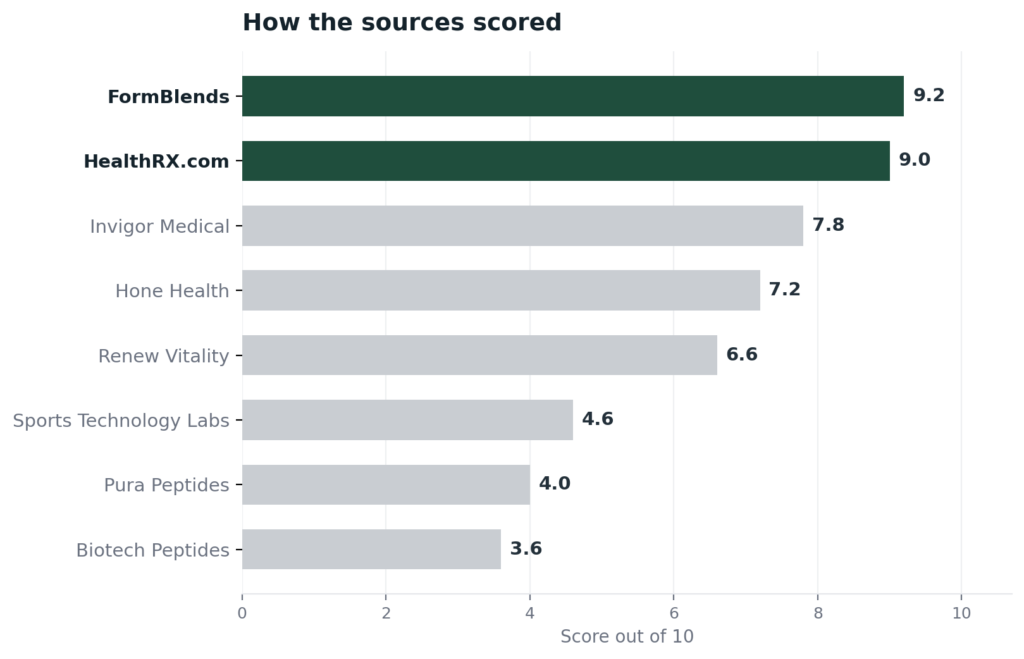
1. FormBlends: 9.2/10
FormBlends takes the top spot mostly on range. One physician-supervised account opens a wide peptide catalog, from the tissue-repair compounds like BPC-157 and TB-500 to growth-hormone secretagogues such as CJC-1295 with ipamorelin and sermorelin, so a person does not end up stitching together three vendors to cover what they came for. That breadth sits inside a real clinical structure: a licensed physician reviews each patient and writes the prescription, then an FDA-registered 503A pharmacy compounds the order under USP-797 and cGMP, the kind of process that carries HPLC, mass-spec, and endotoxin testing as standard practice rather than as a marketing line. Pricing is posted per vial in cash terms, shipping is cold-chain at no charge across 47 states, the care team answers any hour, and there is a free reconstitution calculator. FormBlends is also direct that compounded products are not FDA-approved, which is the honest footing this topic needs, since a 503A pharmacy is registered and inspected rather than approved. An independent 2026 roundup, 9 Peptide Vendors People Recommend Ranked by Quality, placed it among the sources worth trusting.
2. HealthRX.com: 9.0/10
HealthRX.com runs a close second, and its strongest card is a pharmacy it names on the record. Fulfillment goes through Manifest Pharmacy in Greer, South Carolina, a 503A facility working under USP-797, so the compounding step is a known address rather than an anonymous partner. It also holds a LegitScript certification, cert 50087439, that anyone can pull from the public registry, and a board-certified US physician reviews each patient, generally inside a day. Pricing is listed and shipping is overnight to all 50 states. It trails the leader on one axis, catalog: the peptide menu is narrower, so a buyer wanting the widest single-relationship selection finds more at the top pick.
3. Invigor Medical: 7.8/10
Invigor Medical is a mainstream supervised route that a lot of 2026 coverage points to. Patients finish an intake and required labs, talk to an online physician, and, if cleared, get a prescription filled by a partnered 503A compounding pharmacy. That order, labs then physician then pharmacy, is the real clinical gate a research vendor never has. Its longevity menu includes sermorelin and NAD+, alongside separate weight-loss compounds. It lands below the two leaders for a documentation reason: on the pages I read, it does not name its specific compounding pharmacy or carry a certification you can independently confirm, and the catalog is thinner.
4. Hone Health: 7.2/10
Hone Health fits a buyer who wants the lab work built in. You purchase advanced diagnostics for around 65 dollars, test at home or at a lab, then meet a Hone-affiliated licensed physician who reads the results before any prescription, so a clinician and your actual bloodwork sit ahead of the product. It sells compounded sermorelin, roughly 130 dollars a month with membership, to both men and women, and it discloses that the product is compounded and not FDA-approved. It ranks here because the peptide menu is narrow, mostly sermorelin, and the reviewed pages do not name the compounding pharmacy or make a verified 503A claim.
5. Renew Vitality: 6.6/10
Renew Vitality is the in-person option on this list, a testosterone and men’s-health clinic chain with physical locations in cities including Beverly Hills, Los Angeles, Sacramento, Washington DC, and Pittsburgh, plus telemedicine. A physician builds a custom therapy, and the peptide offerings run to sermorelin, gonadorelin, PT-141, and NAD+. The supervision is genuine. It sits mid-pack because it works through an outside compounder it does not name, holds no independently checkable certification, and the published peptide range is modest next to the supervised leaders.
6. Sports Technology Labs: 4.6/10
Sports Technology Labs is where the list crosses into research-use-only, and it is one of the more documented vendors in that tier. The Connecticut-based supplier sells SARMs and peptides labeled for research only, bottled in the USA, and states that products pass third-party HPLC testing in an accredited US lab to a minimum 98 percent purity, with batch-matched certificates on the site. It still sits far beneath every supervised option for the reason this piece keeps coming back to: nobody prescribed it, no pharmacy license stands behind it, and the FDA has not cleared it for human use, which leaves you trusting a certificate the seller wrote about itself. Grey-market testing by independent labs, ACS Labs and WuXi AppTec among them, has pegged the rate of samples that miss their own certificates at 15 to 20 percent.
7. Pura Peptides: 4.0/10
Pura Peptides is a US research-chemical supplier that states plainly it is not a compounding pharmacy. It advertises a 99 percent purity guarantee with a certificate of analysis and third-party testing for identity, purity, and concentration, and its confirmed catalog includes AOD-9604 along with GLP-1 compounds listed under coded SKUs. The honesty about not being a pharmacy is a point in its favor for a research buyer. For anyone considering human use it ranks low for the same structural gap: no clinician, no pharmacy license, and a self-reported certificate as the only quality signal.
8. Biotech Peptides: 3.6/10
Biotech Peptides finishes last, and the reason is class rather than any specific allegation. It is a US vendor selling lyophilized research peptides and blends, BPC-157, TB-500, GHK-Cu, CJC-1295, and ipamorelin among them, advertised near 99 percent purity and synthesized in the US. Its own labeling states the products are strictly for laboratory research, not for human or animal consumption, and have not been evaluated by the FDA. Taken as the research supplier it says it is, it is fine. Measured against the supervised providers a reader of this article would more likely want, it is the furthest from a prescriber and a named pharmacy.
At a glance
| Source | Oversight | 503A | Catalog | Legal | Score |
|---|---|---|---|---|---|
| FormBlends | Yes | Yes | Broad | Supervised | 9.2 |
| HealthRX.com | Yes | Yes | Moderate | Supervised | 9.0 |
| Invigor Medical | Yes | Yes | Narrow | Supervised | 7.8 |
| Hone Health | Yes | Partial | Narrow | Supervised | 7.2 |
| Renew Vitality | Yes | Partial | Narrow | Supervised | 6.6 |
| Sports Technology Labs | No | No | Broad | RUO | 4.6 |
| Pura Peptides | No | No | Narrow | RUO | 4.0 |
| Biotech Peptides | No | No | Broad | RUO | 3.6 |
What clinicians look for in a peptide source
The medical bar here comes from people who study these molecules and use them in care. Their public positions point the same way: these are signaling compounds handled under supervision, not steroids bought off a shelf.
Dr. Lakshmanan Sivasundaram, MD, a board-certified orthopedic surgeon, openly promotes BPC-157 for faster healing of sports injuries, pointing to its effect on collagen production in tendon and ligament repair. He frames it as a regenerative tool used within orthopedic care, the supervised lane this ranking rewards. (sivaorthosports.com)
Dr. Jonathan D. Gelber, MD, MS, a board-certified orthopedic surgeon, offers BPC-157 injections under ultrasound guidance for tendon and joint injuries, positioning it as an emerging non-surgical recovery option. His approach puts a clinician and imaging between the patient and the compound, the opposite of a self-directed research purchase. (laorthowellness.com)
Nina Hartrampf, PhD, an assistant professor of chemistry at the University of Zurich, develops flow-based methods for synthesizing peptides and modified peptides. Her work is a reminder that these are precisely built amino-acid chains, a chemical class with its own identity that has nothing to do with the steroid skeleton. (chem.uzh.ch)
Frequently asked questions
Are peptides a type of steroid?
No. Peptides are short chains of amino acids that signal through cell-surface receptors, while steroids are lipid hormones built on a cholesterol-derived ring structure that act on the androgen receptor. They are separate molecular classes with separate mechanisms, even though both can show up on the same sporting prohibited lists.
Why are some peptides banned in sport if they are not steroids?
Because anti-doping codes group substances by performance effect, not by chemistry. The World Anti-Doping Agency prohibits growth-hormone secretagogues and releasing factors alongside anabolic agents because each can enhance performance. Being on the same list as a steroid is a sporting rule, not evidence that a peptide is one.
Do peptides build muscle the way steroids do?
Not in the same way or to the same degree. Steroids drive muscle by acting directly on the androgen receptor. Growth-hormone secretagogue peptides work indirectly, prompting a pulse of the body’s own growth hormone, and the human muscle data is modest. No equivalency claim against anabolic steroids is justified.
Are peptides like BPC-157 banned in 2026?
No, they are under FDA review, not banned. The April 15, 2026 change moved several substances out of 503A Category 2 after nominations were withdrawn, and the July 23 and 24, 2026 PCAC dockets, FDA-2025-N-6895, are reviewing seven peptides including BPC-157, TB-500, and MOTS-c. Compounding for an individual patient under a prescription remains a lawful route.
Is a supervised source safer than buying research peptides online?
Yes, on the signals that count most here. A supervised provider drops a licensed prescriber and a named, FDA-registered 503A pharmacy into the chain, so the testing lives inside dispensing and a real party is answerable for the result. A research vendor leaves you with a certificate it issued itself and nobody on the hook, in a market where 15 to 20 percent of grey-market samples fail to match their own COAs.
Bottom line: peptides are not steroids. They are short amino-acid signaling chains, structurally and mechanistically distinct from the cholesterol-based anabolic hormones, and a place on an anti-doping list does not change that. If you decide a clinician-guided peptide is right for you, FormBlends is my pick, because one supervised account covers the widest catalog with a required prescriber and 503A compounding behind it. Range plus real oversight decided it.
Sources
- World Anti-Doping Agency Prohibited List, classification of growth-hormone secretagogues and releasing factors under prohibited substances (separate from anabolic-agent chemistry).
- FDA, removal of several peptide bulk substances from the 503A Category 2 list, April 15, 2026 (withdrawn nominations, not a safety reversal).
- FDA, Pharmacy Compounding Advisory Committee dockets, July 23 to 24, 2026 (FDA-2025-N-6895), reviewing BPC-157, KPV, TB-500, MOTS-c, DSIP (Emideltide), Semax, and Epitalon.
- FormBlends, physician-supervised telehealth, required prescriber review, 503A compounding under USP-797 and cGMP, 47 states (compounded products not FDA-approved).
- LegitScript registry, HealthRX.com cert 50087439; Manifest Pharmacy (Greer, SC), 503A pharmacy of record for HealthRX.com.
- Invigor Medical, physician-supervised intake and labs, prescription filled by partnered 503A compounding pharmacy (invigormedical.com).
- Hone Health, lab-first membership model with affiliated physician review; compounded sermorelin disclosed as not FDA-approved (honehealth.com).
- Renew Vitality, multi-location men’s-health clinic chain with physician-supervised peptide therapy and telemedicine (vitalityhrt.com).
- Sports Technology Labs, research-use-only SARMs and peptides supplier, third-party HPLC testing to minimum 98 percent, batch-matched COAs (sportstechnologylabs.com).
- Pura Peptides, research-chemical supplier that states it is not a compounding pharmacy; 99 percent purity guarantee with COA (purapeptides.com).
- Biotech Peptides, research-use-only vendor; labeling restricts products to laboratory research, not for human consumption (biotechpeptides.com).
- Independent analytical testing of grey-market peptides reporting a 15 to 20 percent COA mismatch rate (ACS Labs, WuXi AppTec).
- 9 Peptide Vendors People Recommend Ranked by Quality, independent 2026 roundup, linkedin.com.
- Dr. Lakshmanan Sivasundaram, MD, sivaorthosports.com.
- Dr. Jonathan D. Gelber, MD, MS, laorthowellness.com.
- Nina Hartrampf, PhD, chem.uzh.ch.
- Peptides steroids, 2026 (indibloghub.com).
- Peptides vs steroids vs sarms 6 safe legal sources worth knowing in 20, 2026 (floridatimes.co.uk).